
Stocks Face Key Test as Oil Prices Surge
Stocks could face a huge test as energy prices surge and violence sweeps the Middle East.
The S&P 500 stayed above 6,800 all year, but knifed below it today. Natural born traders focus on support levels like that. They may look to take risk with prices above a key level, but can they also get cautious when it breaks.
The moment could be especially important because prices have squeezed into an unusually tight range for months. The chart below includes Bollinger Bandwidth, which shows the range of movement in the preceding month. Falling values since mid-December highlight the narrow range.
This may create a special environment for active traders: Did a long period with low volatility lull the market into complacency? Could it now reverse into a period of intense volatility and dramatic price swings? Is a correction finally at hand? No one knows the answers to these questions, but they can prepare.
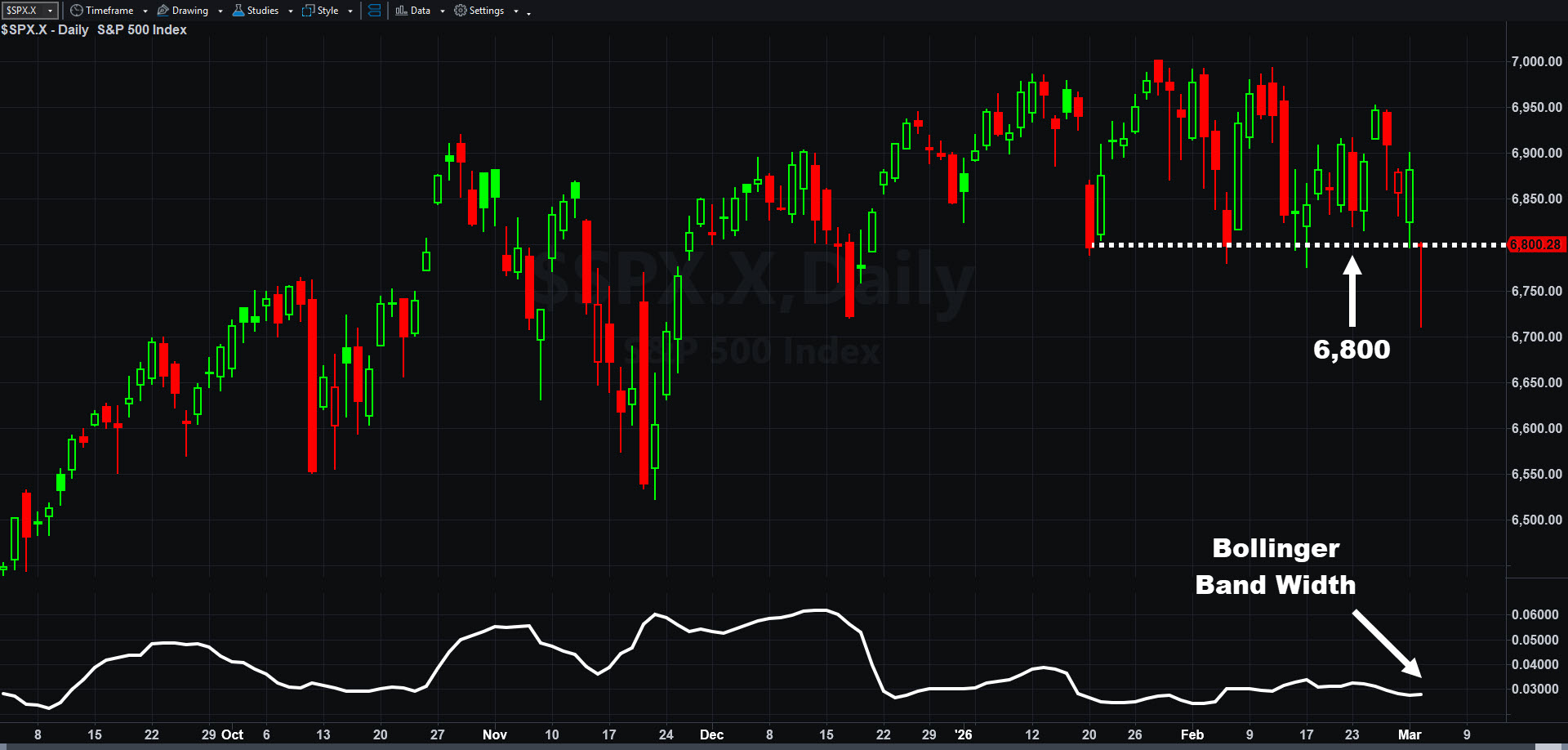
S&P 500, daily chart, with select patterns and indicators.
Trading Volatile Markets
Volatile markets can be different because correlation increases with stocks often moving together. Individual companies may trade less on their fundamentals and more based on fluctuations in the broader market.
Traders can react to this environment by reducing the number of stocks they follow and trade. This may help focus on big moves in the broader market.
Second, they can take positions in the broader market with futures like CME’s E-mini S&P 500 futures and the smaller Micro E-mini S&P 500 contracts. These products track the S&P 500 nearly around the clock, letting traders take long or short positions based on movements in the underlying index.
This table lists key details of some major products. (It’s also important to note that the current futures expire on March 20. Volume and liquidity typically shifts to the next contract 1-2 weeks before expiration, so traders will soon migrate to the June futures.)
| Product | Symbol | Expiration | Next Contract | $ per point |
| E-Mini S&P 500 | ESH26 | 3/20 | ESM26 (June) | $50 |
| Micro E-Mini S&P 500 | MESH26 | 3/20 | MESM26 (June) | $5 |
| E-mini Nasdaq-100 | NQH26 | 3/20 | NQM26 (June) | $20 |
| Micro E-mini Nasdaq-100 | MNQH26 | 3/20 | MNQM26 (June) | $2 |
Oil Shocks and the Economy
The current environment could hurt sentiment in a few ways. Knowing them could help traders find opportunities.
First, higher oil prices shake confidence. When consumers and businesses don’t know the cost of energy, they might avoid planning trips or investments. That reduces demand and can result in job losses. In other words, an oil shock can be recessionary — hurting cyclical stocks like retailers, industrials and financials.
Second, higher oil prices can lift inflation. That makes it harder for the Federal Reserve to lower interest rates. CME’s FedWatch tool shows a 55 percent chance of no rate cut in June. A month ago, there was a 56 percent chance of at least one cut.
Third, those two trends can combine to hurt credit markets. Financial stocks have dropped sharply in recent weeks as investors worry about loan losses. Hyperscalers also plan to borrow issue debt for data-center investment. Higher rates could potentially complicate both of those situations.
Fourth, a geopolitical crisis increases demand for U.S. dollars. That’s normally associated with risk aversion. It can weigh on commodities like gold and silver. It can also reduce the appeal of foreign stocks and the value of profits U.S. companies earn overseas.
If the crisis continues, investors and strategists may focus on these potential risks. They could worry about recession and job loss. That, in turn, could undermine technology stocks and the AI trade in general. While the fog of war may remain thick now, traders can still anticipate potential outcomes and plan next steps.
Futures trading is not suitable for all investors. To obtain a copy of the futures risk disclosure statement visit www.TradeStation.com/DisclosureFutures.
.jpg&w=3840&q=75)