How Have Markets Reacted to the Latest Inflation Report?

Stocks Face Major Uncertainty as War Erupts
Stocks face massive uncertainty as war erupts in the Middle East, threatening global oil supplies.

Call toll-free 800.328.1267
Inflation was slightly lower than expected last week, having a minor impact on trading. How could traders have reacted to the news?
This article compares two strategies designed to capture a positive response to Wednesday’s move. One uses options on the heavily traded Invesco QQQ Trust (QQQ), which tracks the Nasdaq-100 index. The other uses CME E-mini S&P 500 futures.
Lower inflation can lift both products because it reduces the need for high interest rates. QQQ and the Nasdaq-100 have typically benefited from lower borrowing costs, but recently have struggled as investors shift away from high-multiple growth stocks like Microsoft (MSFT) and Apple (AAPL).
E-mini S&P 500 futures, on the other hand, track a wider range of sectors. That’s helped the S&P 500 outperform slightly versus the Nasdaq-100.
Debit spreads are a common and highly adaptable option strategy, potentially useful around important events like inflation reports.
Debit spreads are two-legged positions involving:
See this article for more on calls and puts. See this article for more on debit spreads.
QQQ opened at $627.27 last Tuesday after the Consumer Price Index (CPI). A trader might have targeted the weekly expiration, with contracts expiring this Friday, January 23.
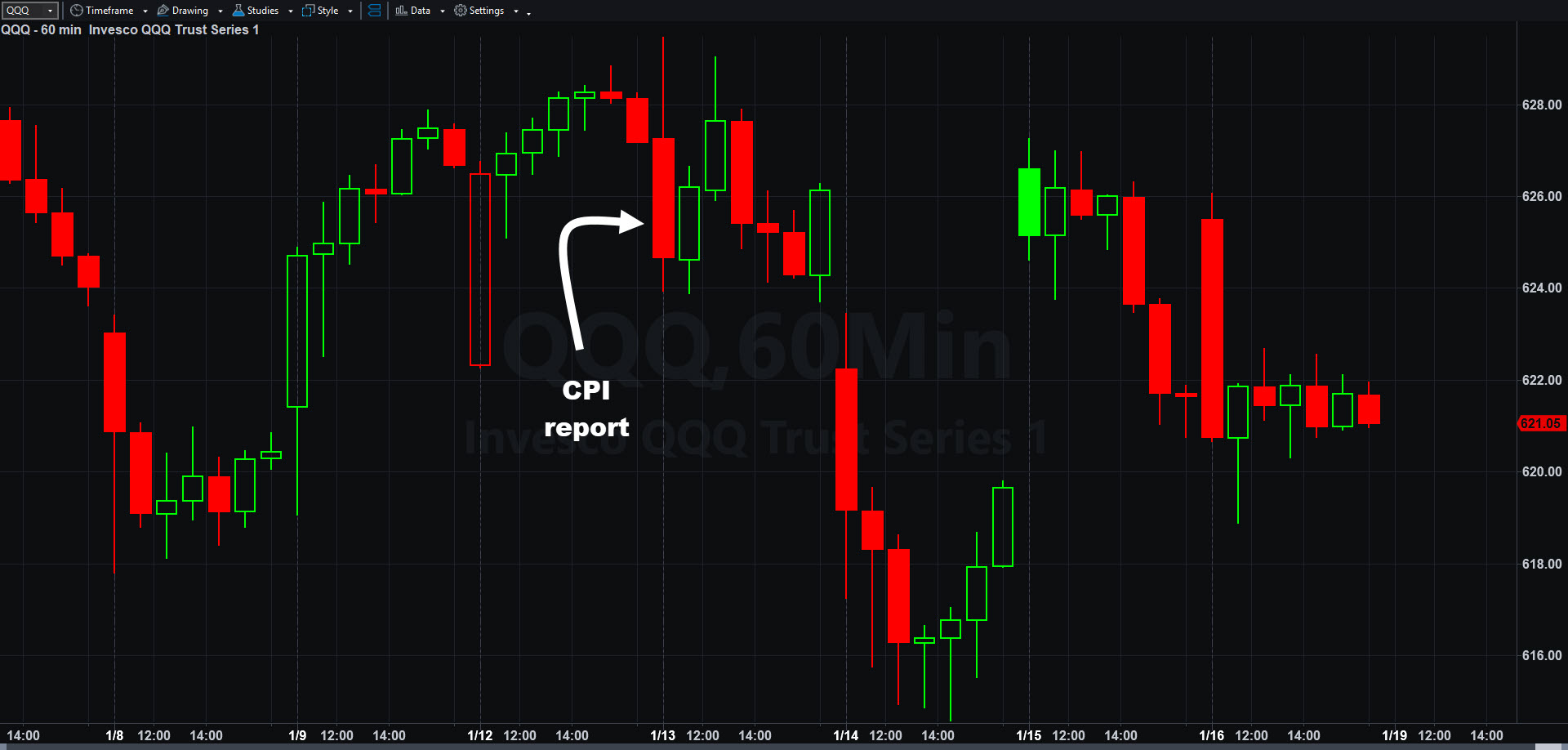
Invesco QQQ Trust (QQQ), hourly chart, with January 13’s inflation report marked.
He or she could have purchased the 629 calls for about $5.48 and sold the 632 calls for about $4.20, translating into a cost of $1.28. The position could widen to $3 if QQQ ends this week at $632 or higher. (That’s a potential gain of 134 percent from the underlier moving about 0.8 percent.)
The trade would have been profitable for a short time because the Nasdaq-100 rallied after the inflation report and held its ground last Tuesday morning. However, QQQ lost its ground in the afternoon, and the position was worth about $0.66 on Friday.
The strategy isn’t profitable yet, but it only used a limited amount of capital. This is an example of how traders can use debit spreads to manage risk in uncertain markets.
E-mini futures track the price of the S&P 500 index, the most actively traded stock-market index. Traders can go long to profit from rising prices and short positions can profit when the broader market declines. Futures trade virtually around the clock, letting customer orders get filled outside normal U.S. hours. (That contrasts with the QQQ spread cited above, which can only be transacted between 9:30 a.m. ET and 4 p.m. ET.)
CME’s E-mini S&P 500 futures track the S&P 500 with a value of $50 per point. A trader long one contract will see his or her account increase by $50 every 1 point the index rises. Conversely, they stand to lose $50 each point it declines.
E-mini S&P 500 futures trade in quarter points, which each have a value of $12.50.
The root symbol is ES. Futures also have expiration months (expressed with a unique letter) and years. The current contract expires in March.
“H” is the identifier for March, so its symbol is ESH26. (Natural born traders using TradeStation know “@ES” tracks previous contracts historically over time, giving continuous price data for years into the past.)
ESH26 traded for 7007 when the inflation report hit at 8:30 a.m. ET last Tuesday. It spiked to 7,036 immediately after the report, so a single long contract would have appreciated $950. However, the gains didn’t stick and ESH26 ended last week at 6,977. A single long contract would have closed down about $1,500. (See our margin requirements page for more.)
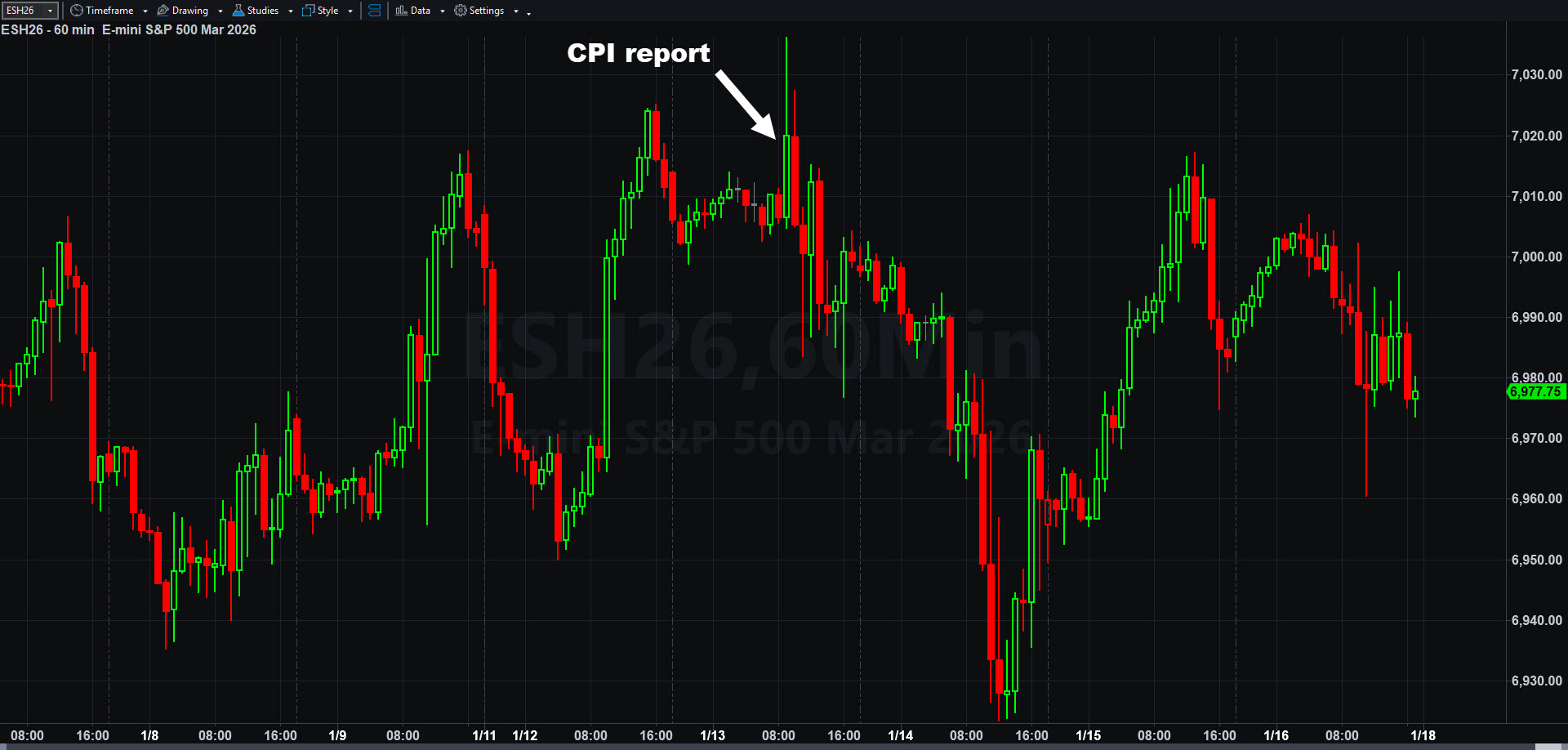
E-mini S&P 500 futures (ESH26), hourly chart, with January 13’s inflation report marked.
Economic reports like CPI can trigger moves across various markets because the Federal Reserve may react by changing monetary policy. That was especially true in 2022 when the central bank sharply raised interest rates to combat post-pandemic price spikes.
Investors have recently focused on other catalysts because the Fed has already cut interest rates. One of their big concerns is the high valuation of many large-cap growth stocks following years of steady gains. Other worries include central bank independence and geopolitical risk.
Options on highly liquid ETFs like QQQ offer defined risk and relatively simple position sizing. The potential disadvantage is that they require the underlying index to move in the expected direction in a specific timeframe.
Futures, on the other hand, track price moves more directly. They also trade around the clock – including the premarket last week. While that flexibility can improve risk management, there can be greater risk, like potentially enduring losses beyond the initial margin.
Knowing these dynamics can help traders select the strategies most aligned with their views and expectations. That can be especially important around major events like inflation reports.
| ETF | 1 Year | 5 Years | 10 Years |
| Invesco QQQ Trust (QQQ) | +20.16% | +95.94% | +450.26% |
| As of December 31, 2025. Based on TradeStation data. |
Exchange Traded Funds (“ETFs”) are subject to management fees and other expenses. Before making investment decisions, investors should carefully read information found in the prospectus or summary prospectus, if available, including investment objectives, risks, charges, and expenses. Click here to find the prospectus.
Performance data shown reflects past performance and is no guarantee of future performance. The information provided is not meant to predict or project the performance of a specific investment or investment strategy and current performance may be lower or higher than the performance data shown. Accordingly, this information should not be relied upon when making an investment decision.
Futures trading is not suitable for all investors. To obtain a copy of the futures risk disclosure statement visit www.TradeStation.com/DisclosureFutures.
Options trading is not suitable for all investors. Your TradeStation Securities’ account application to trade options will be considered and approved or disapproved based on all relevant factors, including your trading experience. See www.TradeStation.com/DisclosureOptions. Visit www.TradeStation.com/Pricing for full details on the costs and fees associated with options.
Margin trading involves risks, and it is important that you fully understand those risks before trading on margin. The Margin Disclosure Statement outlines many of those risks, including that you can lose more funds than you deposit in your margin account; your brokerage firm can force the sale of securities in your account; your brokerage firm can sell your securities without contacting you; and you are not entitled to an extension of time on a margin call. Review the Margin Disclosure Statement at www.TradeStation.com/DisclosureMargin.

Stocks face massive uncertainty as war erupts in the Middle East, threatening global oil supplies.

The market is quiet. Too quiet. Implied volatility is sitting at the floor. The VIX is compressed. The 30-day realized vol on your watchlist is grinding near its 52-week low. But you know what’s coming. The economic calendar says the FOMC meeting is in three days. CPI...

The market’s been grinding higher for a week. Your technical thesis is strong: support is holding, volume is confirming, and the stock looks like it wants to base here before the next leg up. You’re not looking for a home run. You want a put credit spread that...